Today is Stephen King’s 79th birthday. Many words have been written about the man and his words and stories, but his “holy cow!” birthday post on social media got me thinking about all the hours I have spent inside his imagination. I read King’s works heavily from around 1984 to 1991, then just bought his “Dark Tower” books until 2004. I only started reading his new books, and rereading some classics, when the COVID pandemic hit in 2022. I am by no means a completist like I used to be, but I have probably read tens of thousands of King’s words; more than any other author.
Out of my former collection, this movie theater mobile with a photo of a maniacal Stephen King, controlling a bomb of a movie, is one of my favorites. This was filmed in Wilmington, NC, and I wandered around with my parents looking for locations to photograph in 1986. It was a fun day trip during a high school-era summer vacation.
I’ve been thinking about the kernels of my love for genres King swims in: horror, fantasy, sci-fi. There were not many books in my house growing up, let alone horror and sci-fi fiction. My life was already layered with real and imagined horrors since my dad ran a funeral home and drove an ambulance in the pre-EMS 1970s rural south. I heard about the wrecks, shootings, feuds, violence, and gore at a young age. I knew about death and grief and loss as well, and it was at times difficult for my developing brain to understand what was going on emotionally and physically. This gave me a bit of wisdom about my surroundings, but also a tough skin to deal with it. Back then, I also enjoyed scaring myself. It was easy to imagine witches in shadows, trap doors at the stairs, and giant spiders in carports.
A dream takes me back to the early 1990s, when my family cat Simon was still a virile terror, and he lets me scratch his head. I ask him “how come you don’t talk to me like other cats?” Simon decides to chat me up, wanting to talk about how much he liked a woman I dated just down the block. “How come you don’t date her anymore,” Simon asks me.
We start walking while we chat and enter the back of a restaurant. It is a surprise event for me, maybe my birthday. Simon walks me through a smiling crowd of friends and leaves me at a two-top table. The other seat is empty, but Simon tells me that “your sister is your guest for the meal.” He walks into a warehouse gallery space, and I sit at the table enjoying the scene while I wait on my sister.
Stephen Bass just texted me asking when our puppet play “Up a Tree” ran at Intersection for the Arts. My photos and archive of the show was not on this site, and the paper media was in a box in storage. I tried a few different searches via a few search sites, and couldn’t get a hit. I even tried the Wayback Machine to see if Intersection had a decent website then (it was mostly a page of broken images).
Kevin Woodson’s great poster for the show.
I then found the story of the activists vs. Maxxam Corp., including Julia Butterfly Hill and David “Gypsy” Chain, and correctly guessed the show’s run as being in 1999.
Hill famously lived in the top of an ancient redwood tree named Luna (Hill said the tree named herself), and our show featured the tree and the activist. Chain was part of the Earth First! direct action tactic, and was killed when a logger felled a tree on the young man. Chain’s story was also in “Up a Tree”.
“Up a Tree” was a low/no budget puppet installation about the plight of the old growth trees up in Northern California, incorporating marionettes with Bunraku operating options (basically, rods that allowed floor-level performers to manipulate the stringed puppets), shadow puppets for flashbacks, soft hand puppets for the animals in the forest (The boss Fox kept trying to trick the logger Beavers into making as much money as possible for Fox’s multinational corporation). Luna was a huge tree going into the rafters of the puppet stage with real tree bark and moving parts used when the tree spoke to Hill.
This show was thrown together with glue, bins of tree bark, the amazing puppet-crafting skills of Jonathan Youtt and David Morley (Joelle LaPlum probably helped as well), and directed by Dan Chumley (with some visits from Peggy Snyder) of the SF Mime Troupe. I played one of the Beavers, the voice of Chain’s abusive father in the shadow flashbacks, and was on the floor-level to be the Bunraku puppeteer for most of the marionettes (and pulled the rope so Luna could “talk”).
I made friends for life during this show, and also got a masters class in puppetry and theater arts. Julia called in one show a week from her platform in Luna and took questions. We went out to visit the tree and be part of some civil disobedience for an action, and there was a massive circle at the end where a woman gave us all a tincture of Luna’s tree sap. When Julia came down from her 738-day sit weeks later, she came straight to CELLspace to meet us all and get in on the fun when she could.
Other great memories: Michael Franti brought his family to a show one night. Building the set, the puppets, the props, and the redwood bark install at the Intersection’s entrance, was a CELLspace community effort. I even cut an EarthFirst! stencil for Chain’s puppet’s small t-shirt. Pod was our amazing sound tech and Leon Rosen helped with that as well. There’s a video of the show, but I recall the sound being horrible.
Since 2000, all this fun and creativity has been a DIY labor of love. Keeping the Stencil Archive, and HappyFeet Travels, upgraded, updated, secure, and available has taken my gladly-given time and money. If you would like to support these sites, the stencil work, and future projects, please consider giving what you can.
Other ways to support the projects: The out-of-print “Stencil Nation” book is still available and there are now four San Francisco/Oakland street art tours to choose from.
Went to the Wayback Machine to pull out some early-2000s HappyFt images. IYKYK 😛
Relix magazine just put together an entertaining recollection of the 1992 H.O.R.D.E. concert tour, with the festival’s founders (the musicians) going on record about how it all began. Love the fact that most of the tour revolved around giving massive love to Col. Bruce Hampton and the Aquarium Rescue Unit. I am quite humbled that I got to see the ARU at their genesis, b/c their show was straight up different from much of the live music I was going to!
Everybody had this common idea that they had to help Colonel Bruce Hampton and the Aquarium Rescue Unit. That was like the secret squirrel agenda of the whole thing. – Dave Frey, Blues Traveller mgr. (via Relix magazine)
My brother Mark and I knocked out bootleg tee shirts for the Atlanta and Carowinds stops of the first H.O.R.D.E. tour. Mark had the art skills, we both did graphic design, and I was working in a screen print shop. We printed a nice pile, only to have undercover cops confiscate them before we even had a chance to sell any! Luckily, I’d pulled several dozen to sell to friends and keep back for the NC show if we sold out, so still had a few to sell and break even on cost.
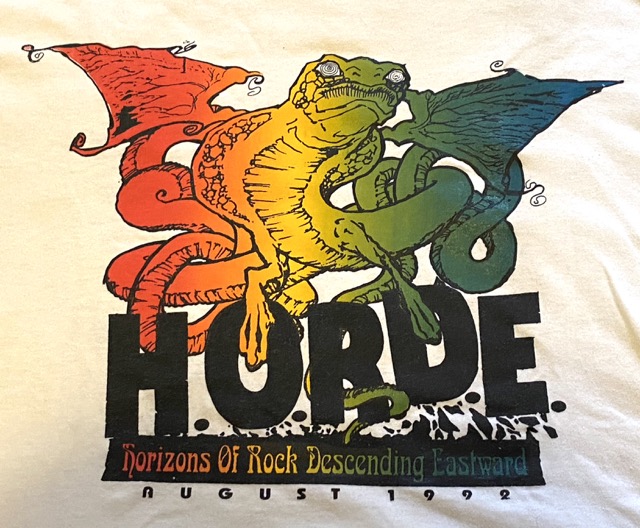
Mark and I had a fun time making the 1992 lot tee image. We thought up and brainstormed the idea, Mark then drew the monster, and we worked on the lettering together via Mark’s Apple computer (and probably Photoshop 1 or 2 or similar). Then I took the file, via a floppy disk, to the Microsoft machine I had at the screen print shop where I worked, printed the front and back images on vellum paper, taped them up and corrected lines, pulled a rubylith separation for the monster’s color screen, and then burned the two screens.
My screen shop boss, Randy, was very cool about letting us schedule our own prints into the shop’s work flow. I’m not sure if he or Freddie, another amazing screenprinter, pulled the ink on these. I bought the shirts at wholesale cost, and whoever did the labor usually got a shirt. We also always helped each other with our own print runs, so the labor usually got paid back in kind. This shirt had a larger run than usual (I think I printed about 3-4 dozen tees), so Randy may have made us do this after hours. Either way, we were all into putting multiple colors into the one screen to easily make the shirt a 4-color job.
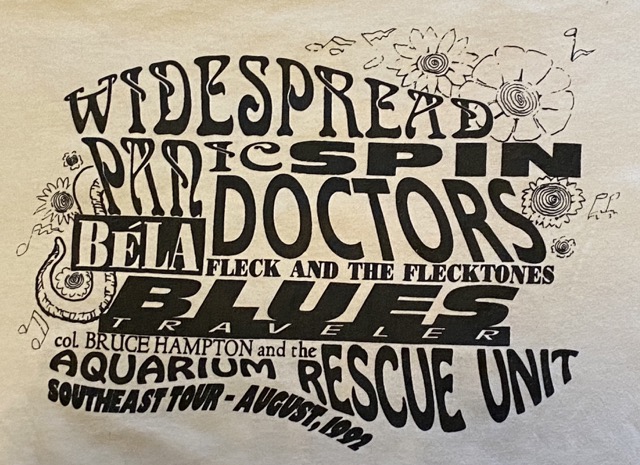
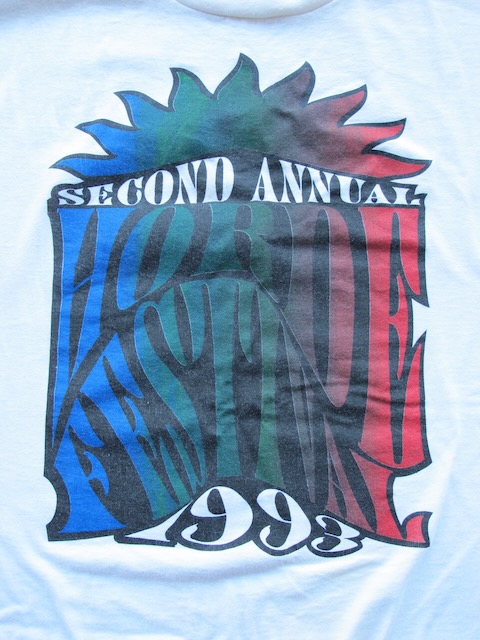
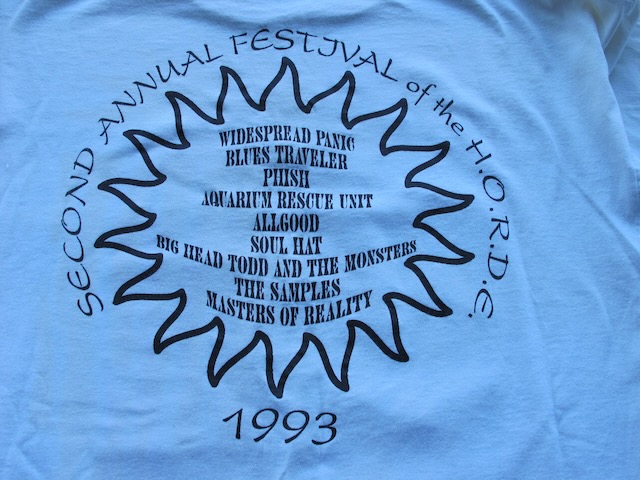
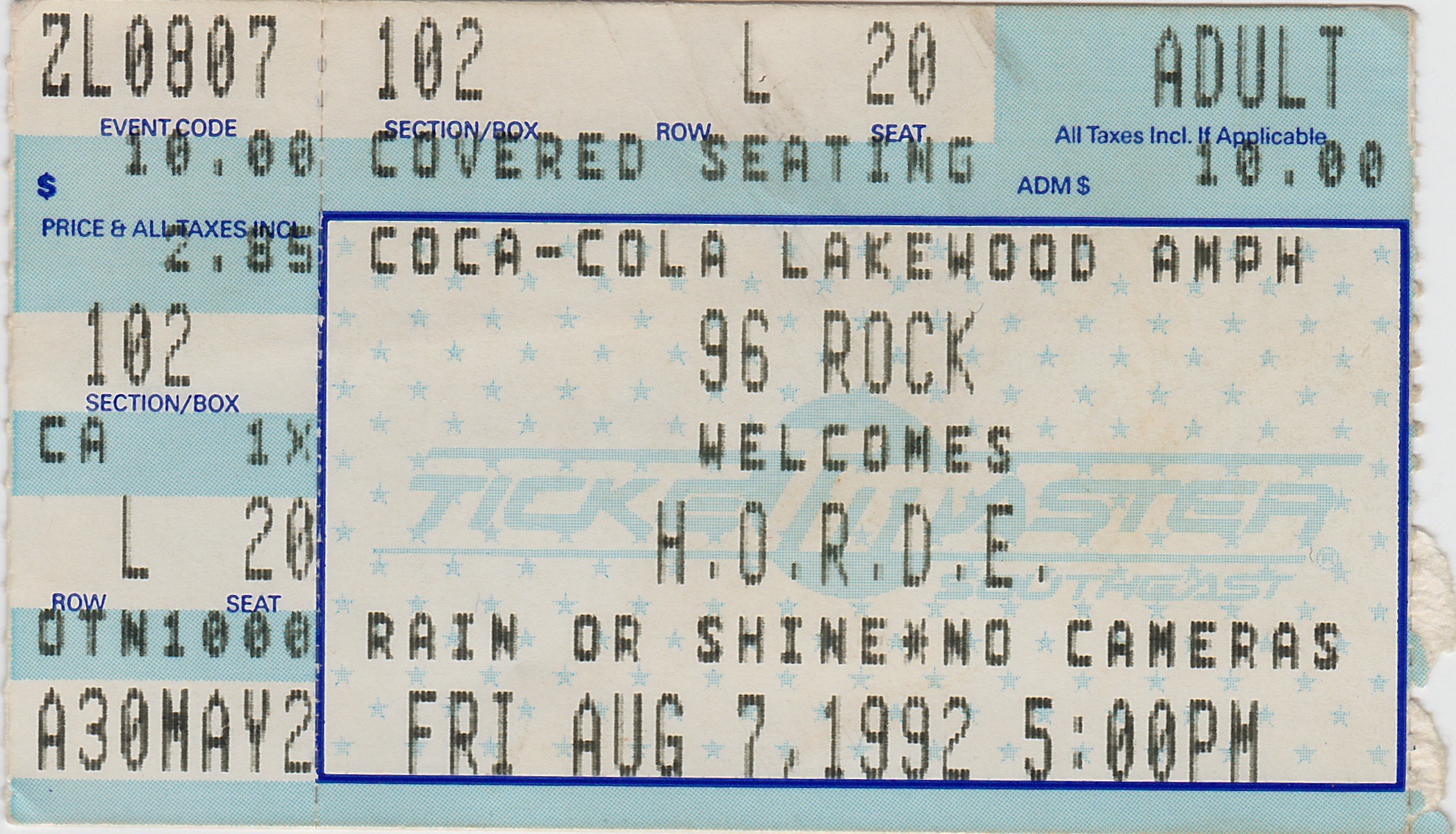
Love this artwork! We didn’t get the correct name of the festival, but must’ve picked the words up from a Widespread Panic mailer. Maybe a Blues Traveller mailer? The correct name is Horizons of Rock Developing Everywhere. Now that I think a bit more, we have just gotten more metal about the idea of a horde monster coming to the Southeast to destroy and slay. 😛 Here’s the back of the 1992 shirt. We spent alot more time on the art and ideas for the first one, only to have most of these shirts get confiscated by the cops. When asked what they’d do with the shirts, they told us they’d give them to a homeless charity in Atlanta. I looked for them in the streets for a month or so after the show.H.O.R.D.E. Festival 1993 shirt. The artwork is simple, so Mark and I must’ve quickly thought this one up.I always made 2-sided shirts, even if there was only a pocket image. Good to have this image to know which bands were in the 1993 festival. I cannot remember which bands I saw at the Atlanta stop of the festival, and this list is for the whole tour (Phish once again headlined the Northeast shows while Panic headlined the Southeast).My stub from the 1992 Lakewood show.My stub from the Carowinds festival in 1992.Here’s the ticket for the 1993 Lakewood show.
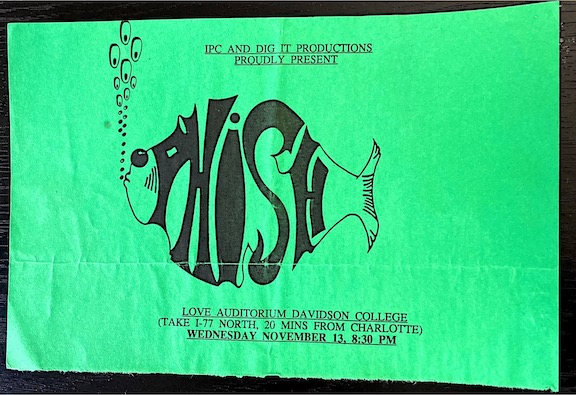
[1] Four Charlie Chan signals and Popeye, Simpsons, Oom Pa Pa, and Random Laugh signals in the intro. The band responded to Popeye signal by singing a random note. [2] Fish sang only one out of every few words. [3] Without microphones.
Terrapin was announced as the “restrained version” and Fish as the “Master of Restraint.” In response, Fish sang only one out of every few words to the song. Trey also clarified during the show that Colonel Forbin is not to be mistaken for Colonel (Bruce) Hampton. Bowie was preceded by a Funk #49 tease. The Bowie intro included HYHU teases, four Charlie Chan signals and Popeye, Simpsons, Oom Pa Pa, and Random Laugh signals. The band responded to the Popeye signal by singing a random note, which is the Random Note signal’s “secret language.” Trey teased Dave’s Energy Guide in Possum. Sweet Adeline was performed without microphones.